
The Online Course Design Rubric Series, Section A: Presenting Your Course Content Online
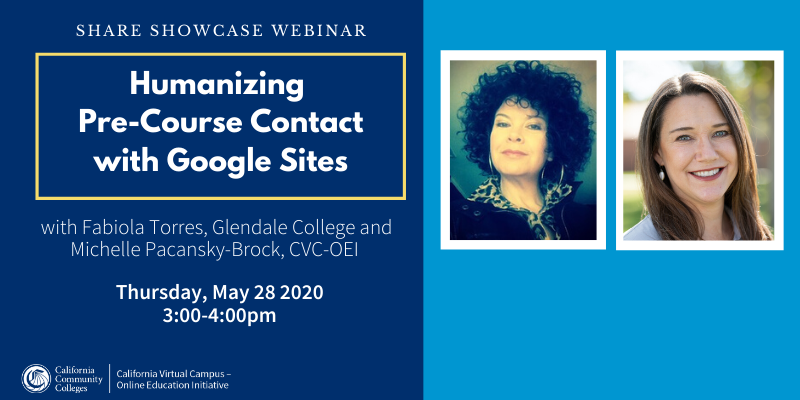
Humanized online teaching practices support the non-cognitive or affective dimensions of student learning. Many students who enroll in online courses, particularly those from minoritized backgrounds, do not successfully log in and complete the first week successfully. Weeks 0-1 comprise a high opportunity zone for increasing the percentage of students who succeed online.
In this session, Fabiola and Michelle will share examples of humanized practices from their online courses that use Google Sites to create a Liquid Syllabus and a Welcome Package for students. Sent before day one, (or embedded in online campus directories) students tap the link and are instantly taken to an accessible webpage that renders beautifully on their phone. By embedding a brief video of yourself at the top of the page, your students will be greeted by your warm, smiling face and feel supported to log-in and be successful in week one.
Presenters:
Fabiola Torres, Ethnic Studies Faculty at Glendale College and CVC-OEI/@ONE facilitator
Michelle Pacansky-Brock, Faculty Mentor, Online Teaching & Learning for CVC-OEI
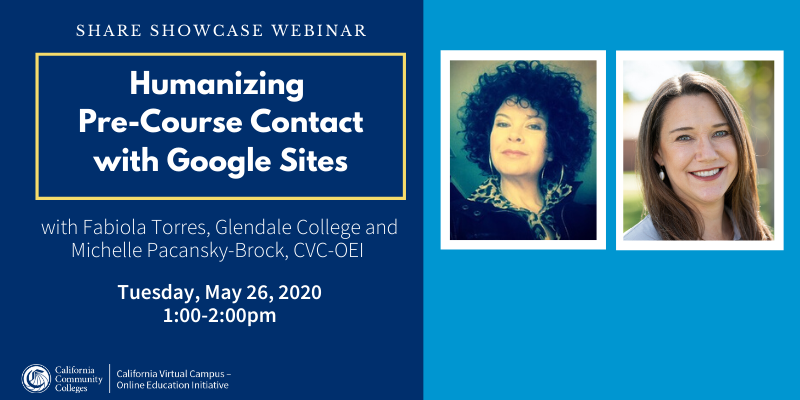
Humanized online teaching practices support the non-cognitive or affective dimensions of student learning. Many students who enroll in online courses, particularly those from minoritized backgrounds, do not successfully log in and complete the first week successfully. Weeks 0-1 comprise a high opportunity zone for increasing the percentage of students who succeed online.
In this session, Fabiola and Michelle will share examples of humanized practices from their online courses that use Google Sites to create a Liquid Syllabus and a Welcome Package for students. Sent before day one, (or embedded in online campus directories) students tap the link and are instantly taken to an accessible webpage that renders beautifully on their phone. By embedding a brief video of yourself at the top of the page, your students will be greeted by your warm, smiling face and feel supported to log-in and be successful in week one.
Presenters:
Michelle Pacansky-Brock, Faculty Mentor, Online Teaching & Learning for CVC-OEI
Fabiola Torres, Ethnic Studies Faculty at Glendale College and CVC-OEI/@ONE facilitator
“To teach in a manner that respects and cares for the souls of our students is essential if we are to provide the necessary conditions where learning can most deeply and intimately begin.” bell hooks - Teaching to Transgress
This event is part of the virtual OLC Ideate program. Free registration is required. Archives will be made available to OLC members.
Once you register for OLC IDEATE, you will be given further instructions about how to access the salons in OLC’s Learning Management System.
Register for OLC Ideate:
https://docs.google.com/forms/
In this OLC Ideate Discussion Salon, participants will be introduced to the principles (and some examples) of Humanizing Online Teaching, a theoretical framework that fosters equity and inclusion by bringing together Culturally Responsive Pedagogy, Social Presence, Validation Theory and more. Participants will have an opportunity to break into small groups and discuss/share ideas to integrate into their own practice as a way to build empathy and connection with students.
This event is part of the virtual OLC Ideate program. Free registration is required. Archives will be made available to OLC members.
Once you register for OLC IDEATE, you will be given further instructions about how to access the salons in OLC’s Learning Management System.
Register for OLC Ideate:
https://docs.google.com/forms/
A six-part webinar series presented by the California Community Colleges Chancellor's Office and the USC Rossier Center for Urban Education. The series provides strategies for faculty and administrators to exercise agency of behalf of the most vulnerable students.
A six-part webinar series presented by the California Community Colleges Chancellor's Office and the USC Rossier Center for Urban Education. The series provides strategies for faculty and administrators to exercise agency of behalf of the most vulnerable students.
A six-part webinar series presented by the California Community Colleges Chancellor's Office and the USC Rossier Center for Urban Education. The series provides strategies for faculty and administrators to exercise agency of behalf of the most vulnerable students.
A six-part webinar series presented by the California Community Colleges Chancellor's Office and the USC Rossier Center for Urban Education. The series provides strategies for faculty and administrators to exercise agency of behalf of the most vulnerable students.
A six-part webinar series presented by the California Community Colleges Chancellor's Office and the USC Rossier Center for Urban Education. The series provides strategies for faculty and administrators to exercise agency of behalf of the most vulnerable students.